
Below are the monthly updates from the most current February 2026 fuel price data (GasBuddy.com) and December 2025 electricity and natural gas price data (US Energy Information Administration). To view additional data and analysis related to the California economy visit our website at www.centerforjobs.org/ca.
The latest data again shows California with the highest or near the highest energy costs among the contiguous states. The industrial electricity rate slipped into second place, marginally behind Rhode Island, while residential natural gas prices edged up to the 3rd highest. Ranking for the average monthly residential electricity bill continued easing as rates and usage grew in other states due to clean energy policies and restrictions on pipelines.
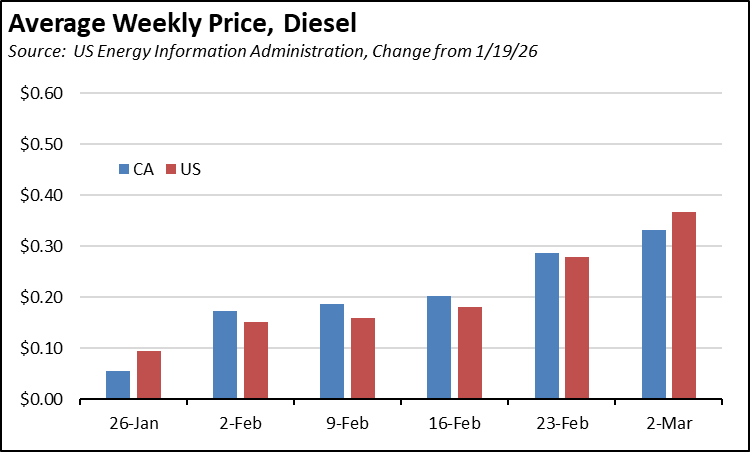
Fuel prices have since begun to rise further as a result of the actions in Iran causing crude prices to rise. As discussed further in one of our Data Insights from earlier this week, fuel prices were already rising due to seasonal factors including the biannual changeover in fuel specifications and increased driving activities and in California, the current process under which 18% of the state’s refinery capacity is closing due to state policies. These price increases were far more substantial in California, with the latest run-up adding 49.8 cents a gallon in California through the week of March 2 in the weekly average prices, compared to 20.9 cents in the US average. Price increases in the more constrained diesel markets were 33.2 cents in California and 36.7 cents in the US average in this period.
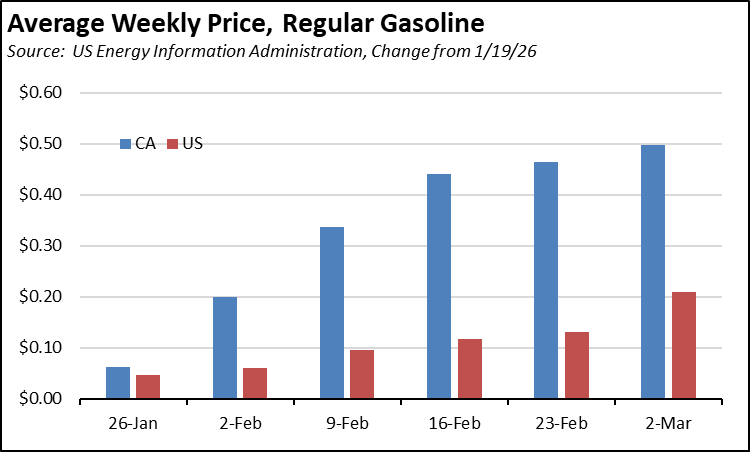
Since March 2, fuel prices have risen in tandem with global crude prices. Using the daily results from AAA, regular gasoline was up another 15.3 cents a gallon through March 5 in California and 25.4 cents in the US average. Although substantial, the additional pump increase to date is still significantly less than the price increase already imposed on Californians this year from the state energy policies.
Diesel was up 32.5 cents in California since March 2 and 39.6 cents in the US. As noted by energy market analyst Patrick DeHaan, the larger response for diesel is due to a number of factors: The diesel market is simply tighter, and with drone attacks on a Saudi refinery, Qatar shutting down natural gas production, boosting heating oil use, and lower U.S. inventories amidst cold weather, diesel has out-rallied gasoline.
Also according to DeHaan, the current price jump is likely to ease as the wholesale price changes finish flowing to the retail sector. The present price situation reflects uncertainty and the markets building in risk factors rather than supply effects. Supply pressures, however, could begin to emerge depending on how long shippers continue to avoid using the Strait of Hormuz. Although elevated over recent months, the current California gasoline price reflects levels previously seen as recently as last April and May.
What is guaranteed is that California policies will continue driving up prices on their own regardless of the international picture. The state is now launching into an unknown future with a refinery capacity well below its own needs let alone the supplies now going to Arizona and Nevada. Recent regulation changes especially the Low Carbon Fuel Standard are beginning to exhibit their predicted pressure on prices. And in spite of professed concerns over affordability and spillover from the Iran action, the state continues to add to the regulatory cost burden even during the present crisis including, as discussed below, amendments that will significantly Cap and Trade costs along with other regulatory mandates such as the just adopted climate change reporting mandates. Also looming on the horizon is the annual increase in the state fuel taxes, again pushing rates up well ahead what is charged in other states.
Inflation
For the 12 months ending December, the California CPI rose 3.2%, easing from 3.6% for the year ending November. In the same period, the US CPI remained at 2.7% over both months. Using the same Department of Finance weighting formula, Food at Home (groceries) rose 2.6% in California compared to 2.4% for the US. Food Away from Home (restaurants and takeout) rose 3.5% compared to the US at 4.1%.
California Gasoline Taxes & Fees
Gallon of Gasoline
As we have discussed in prior reports, in the absence of current Energy Commission data, we have begun our own estimates using the Commission factors and the new OPIS data. In February, $1.47 (32.0%) of the price of a gallon of regular gasoline was paid to cover state, local, and federal taxes and fees.
California Carbon Taxes: LCFS and Cap & Trade
In February, total LCFS charges incorporated in the price Californians pay for fuel rose 3 cents for gasoline and 4 cents for diesel, while the Cap & Trade component showed a 2 cent decrease for both fuels. The costs shown in the table are for the penultimate month-to-date numbers from the OPIS Carbon Market Report, adjusted to incorporate state and local sales tax to account for the full additional costs imposed by these regulatory fees on fuel buyers. Certain Data or Information Provided By: Oil Price Information Service, LLC. Distribution of OPIS data without permission from OPIS is prohibited.
Combining the OPIS data (without the sales tax component) with the previous Energy Commission estimates, Cap & Trade costs have been largely stable, although the current rulemaking by CARB is currently on track to increase these costs by an estimated average of 124% over the next 10 years. LCFS costs have been rising sharply, growing by 7 cents a gallon for gasoline since the amended regulations became effective last summer. Note that both charts include both the Cap & Trade components charged at the rack and levied on production from the OPIS data, and only the rack component in the Energy Commission data.
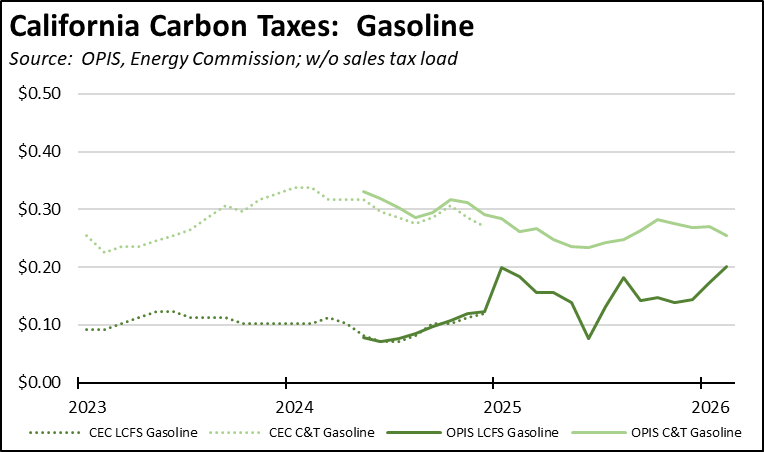
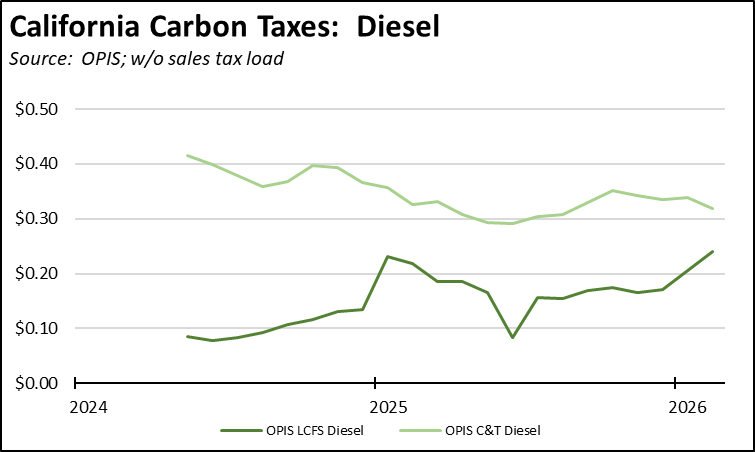
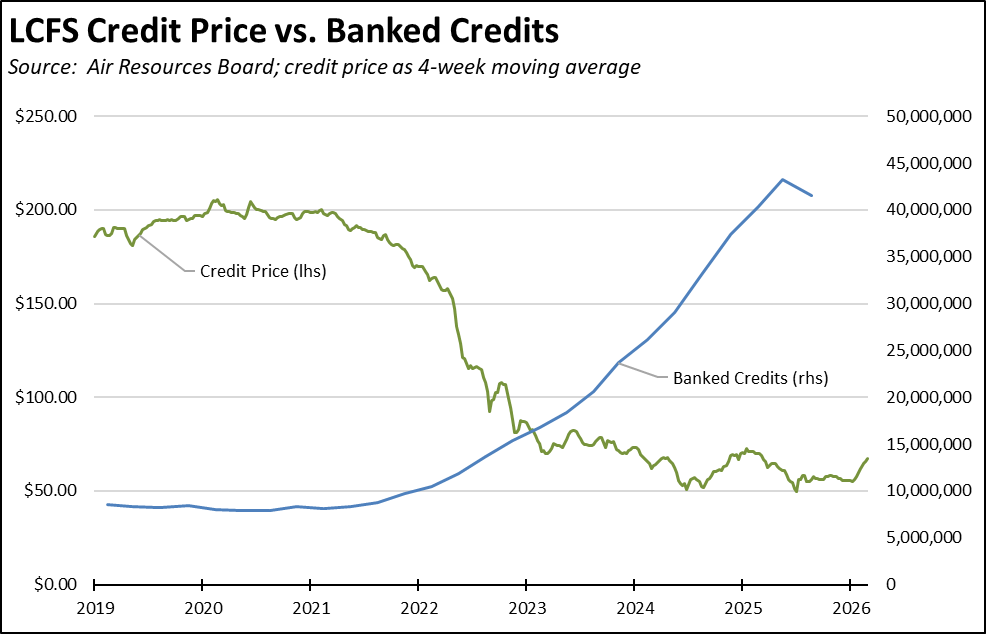
The underlying credit prices for LCFS have shown a sustained rise during a period that otherwise showed price easing in prior years, with the 4-week running average growing by 22% since the beginning of the year. Longer term price effects, however, remain governed by the extreme amount of banked credits still remaining in the system, although the latest report from CARB shows the first quarterly decline as the amended regulations begin to eat into this price buffer.
California vs. Rest of US Diesel Price
Above Other States
(CA Average)
The February average price per gallon of diesel in California rose 19 cents from January to $5.09. The California regulatory and tax premium above the average for the US other than California ($3.65) remained level at $1.44, a 39.4% difference.
price
In February, California had the highest diesel price among the contiguous states and DC.
Range Between Highest and Lowest Prices by Region
above Other States
(Central Sierra Region)
The cost premium above the US (other than California) average price for regular gasoline ranged from $1.65 in the Inland Empire Region (average February price of $4.50), to $1.92 in Central Sierra Region (average February price of $4.77).
Highest/Lowest Fuel Prices by Legislative District:
The data series for Congressional Districts has again been revised to conform to the 2025 district lines. The revised estimates including prior year are available on the Center’s website.
California Residential Electricity Price
Rest of US
California average Residential Price for the 12 months ended December 2025 was 32.48 cents/kWh, 97.6% higher than the US average of 16.44 cents/kWh for all states other than California. California’s residential prices were the highest among the contiguous states and DC.
California Residential Electric Bill
For the 12 months ended December 2025, the average annual Residential electricity bill in California was $1,871, or 88.2% higher ($877) than the comparable bill in 2010 (the year the AB 32 implementation began with the Early Action items). In this same period, the average US (less CA) electricity bill for all the other states grew only 33.0% ($451).
In 2010, California had the 9th lowest residential electricity bill among the contiguous states and DC. In the latest data, it had the 19th highest.
Residential bills, however, vary widely by region. Transforming the 2022 data recently released by the Energy Commission, estimated annual household usage is as much as 82% higher in the interior regions compared to the milder climate coastal areas, and substantially higher when comparing across counties.
Rest of US
For the 12 months ended December 2025, California’s higher electricity prices translated into Residential ratepayers paying $13.2 billion more than the average ratepayers elsewhere in the US using the same amount of energy. Compared to the lowest cost state, California households paid $17.0 billion more.
California Commercial Electricity Price
Rest of US
California average Commercial Price for the 12 months ended December 2025 was 26.28 cents/kWh, 111.6% higher than the US average of 12.42 cents/kWh for all states other than California. California’s commercial prices were the highest among the contiguous states and DC.
California Industrial Electricity Price
Rest of US
California average Industrial Price for the 12 months ended December 2025 was 21.66 cents/kWh, 168.4% higher than the US average of 8.07 cents/kWh for all states other than California. California’s industrial prices were the 2nd highest among the contiguous states and DC, marginally behind Rhode Island.
Rest of US
For the 12 months ended December 2025, California’s higher electricity prices translated into Commercial & Industrial ratepayers paying $21.5 billion more than ratepayers elsewhere in the US using the same amount of energy. Compared to the lowest rate state, Commercial & Industrial ratepayers paid $28.1 billion more.
California Natural Gas Prices
Average prices ($ per thousand cubic feet; 12-month moving average) for the 12 months ended December 2025 and changes from the previous 12-month period for each end user: