
ZEV Market Share: Largely Unchanged at 26.1% in 2025; Plunges to 15.7% in 2026:Q1
In the latest report from California New Car Dealers Association (CNCDA) and as defined by CARB, total ZEV registrations (PEV—plug-in electric vehicles that include both battery electric vehicles (BEV) and combustion engine plug-in hybrids (PHEV)) in 2025 posted a 26.1% market share of total new light duty vehicle (LDV) registrations. This level was little changed from the prior two years and again indicated that rather than growing to conform to the state’s previously mandated goals, the market had essentially reached saturation under the current model lineup rather than expanding under the prior federal and state subsidies.
In 2026:Q1, sales fell sharply to a 15.7% share, the lowest since 2021:Q3. Gasoline hybrids (HEVs) in contrast edged up to their highest level ever at a market share of 20.9%.
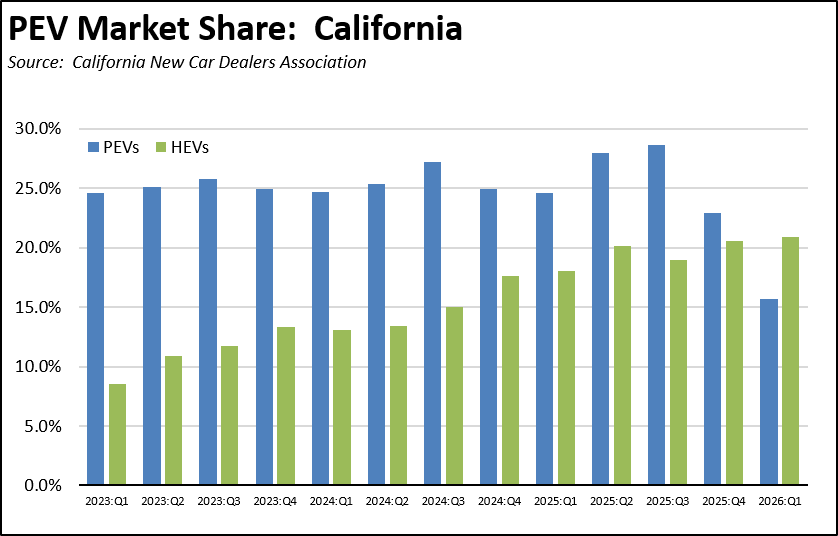
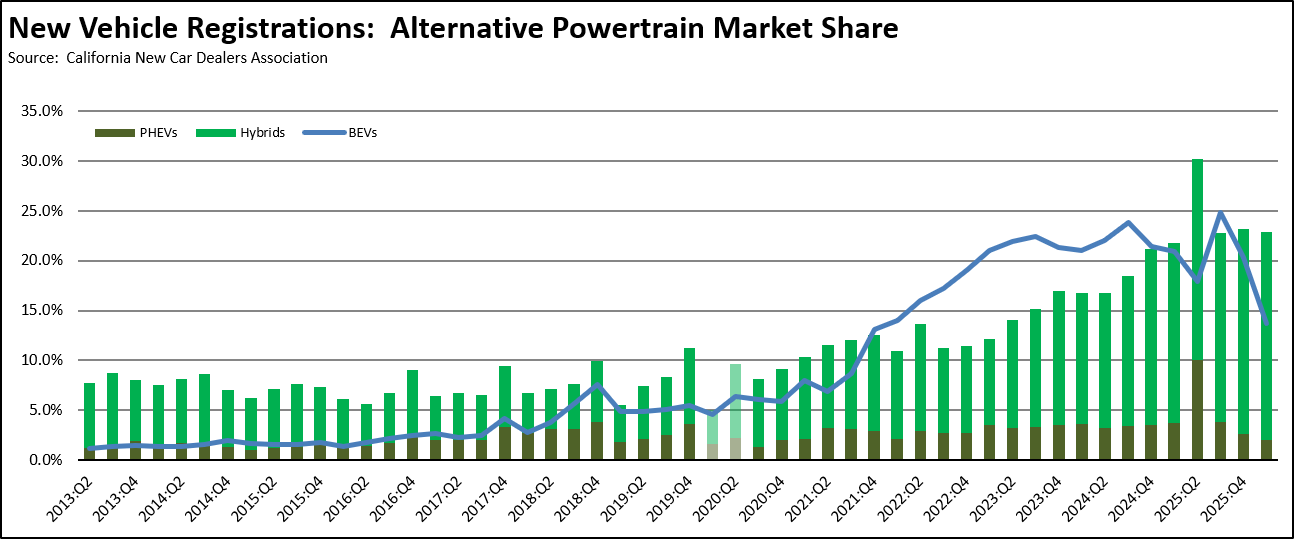
Hybrids—both PHEVs and HEVs—have shown a sustained rise in sales, with hybrids outselling BEVs in the past two quarters. This trend is in contrast to the early years of the state’s regulations during which the alternative powertrain market was largely fixed, and PEV sales largely replaced rather than added to the HEV sales.
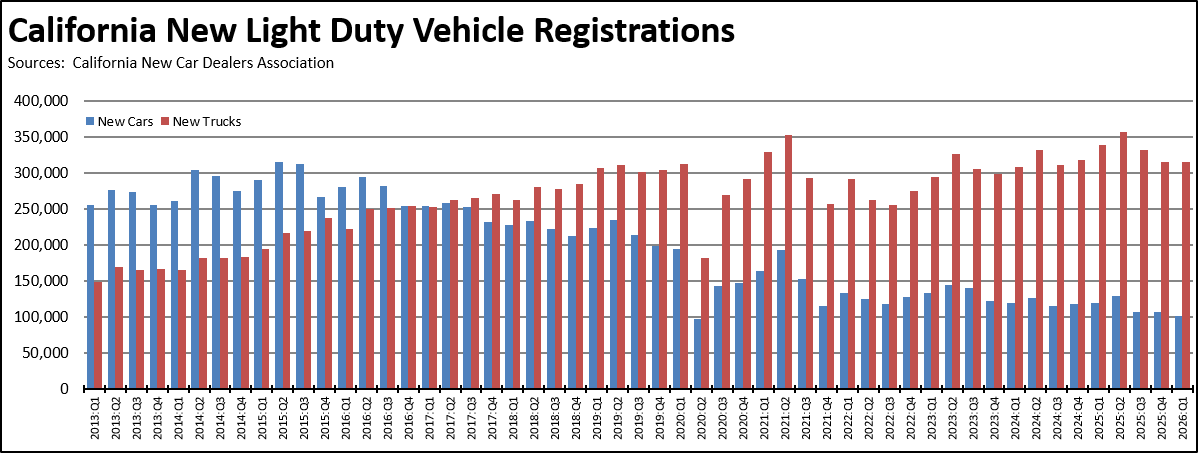
The PEV market share numbers are even weaker when considering the current trend in total new LDV registrations. In 2025, new LDV registrations rose 3.3% over the year in California, behind the overall growth of 4.2% in the US. The 2026:Q1 results fell 8.9% compared to 2025:Q1 in California, more steeply than the 4.6% drop for the nation. CNCDA now expects total sales in 2026 to dip 3.4% from 2025, as the result of high interest rates, high new vehicle prices, and continuing uncertainty due to tariffs and fuel prices.
California Falls Short of Its ZEV Goals
California’s previous goal was to have 1.5 million electric vehicles on the road by 2025. Energy Commission data indicates the state surpassed this benchmark by having 2.2 million in 2025, consisting of 1.8 million registered true electric vehicles (BEVs), 11,940 fuel cell vehicles, and 471,000 plug-in hybrids (PHEVs) running mostly on their combustion engine component.
That goal, however, was set in Executive Order B-48-18, and was since superseded by Executive Order N-79-20 along with the subsequent regulations from the Air Resources Board. Under those measures, the state’s goal shifted to ZEVs (BEVs, fuel cells, and combustion engine PHEVs) being 35% of light duty vehicle sales in 2026, and reaching 100% by 2035. The new vehicle registration data shows the state was already falling behind in attaining this goal in the second half of 2023, and under the current trend, will miss this now non-binding mark by a wide margin this year.
In 2025, the ZEV market share reached 26.1%, not substantially different from 25.5% in 2024 and 25.1% in 2023, and well below the 31.7% it would have had to hit in order to stay on track with the state’s previously mandated goal.
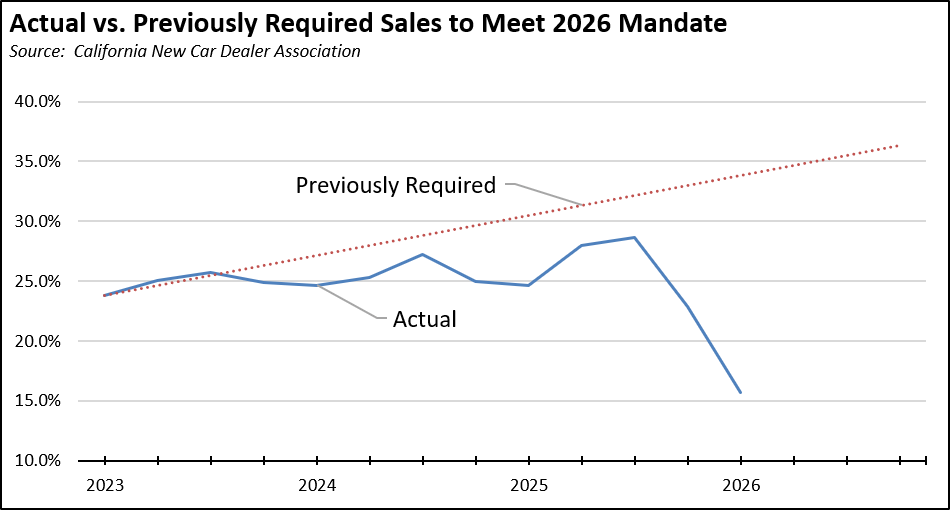
Instead the data shows that ZEV sales by market share essentially plateaued in the second half of 2023 as sales of the available model offerings—geared towards the higher end of the market—essentially reached saturation levels. The market is now adjusting to sales under what are now in fact market conditions rather than the previous situation of compliance model offerings combined with heavy subsidies from taxpayer funds to help largely white (83.5% of California ZEV owners), upper income (68.8% with household income of $100,000 or more) males (79.8%) better afford $57,000 vehicles.
In the process, producers are now becoming focused more on producing models customers will buy rather than models produced to comply with the regulations, especially higher-priced models with higher margins needed to stem losses in this market segment. One example is Ford’s F-150 Lightning truck, which was widely panned for among other things its shortcomings on carrying the loads that people who buy these trucks buy the trucks for. Ford instead is replacing it with yet another ZEV category, the EREV (extended range electric vehicle) that essentially is a PHEV in reverse, built on a BEV power train but with an auxiliary gasoline generator used to extend range and consequently load capacity. Another example also comes from Ford which is now developing a $30,000 pickup BEV, which if successful would provide a break through on several points: (1) produce at a price point that is generally regarded as essential to ZEVs becoming a mass market product, (2) focus on the light trucks consumers actually want to buy, and (3) reassert US manufacturers into the key small pickup segment that as discussed below is currently selling for an average price of over $43,000.
The auto producers have long had conflicting reactions to the state’s ZEV mandates. In the beginning years of these regulations, the engineering side of the companies showed substantial enthusiasm from the simple fact that electric vehicles opened up what they could explore and develop rather than continuing to fine-tune an hundred-year-old technology. The marketing side, however, showed more caution, concerned that a rushed introduction resulting in negative reports of customer experience would set back the possible market for ZEVs for an extended period of time. The state’s regulatory approach navigated this situation for several years, but the forced adoption of the 100% regulations resulted in an introduction capable of serving a portion of the upper tiers of the market but that fell far short of the goal of making ZEVs the go-to solution for the mass market. Electric vehicles continue to sell, but nowhere near the goal set in the state’s regulations.
Electric Vehicle Prices Essentially Stable Since the Second Half of 2023
The most recent results from Kelly Blue Book indicate the average transaction price for electric vehicles at $55,211 in April. Although prices have varied within a $5,000 range, the overall level has shown little change since the second half of 2023, both before and after the federal tax credits and in contrast to the expectations behind mandates such as California’s that as volumes increase, these vehicles would become more affordable. Also in contrast to expectations, electric vehicles show a near term decline of $3,900 since expiration of those credits last fall.
Prices for new vehicles overall also remained high, with the April average at $49,461.
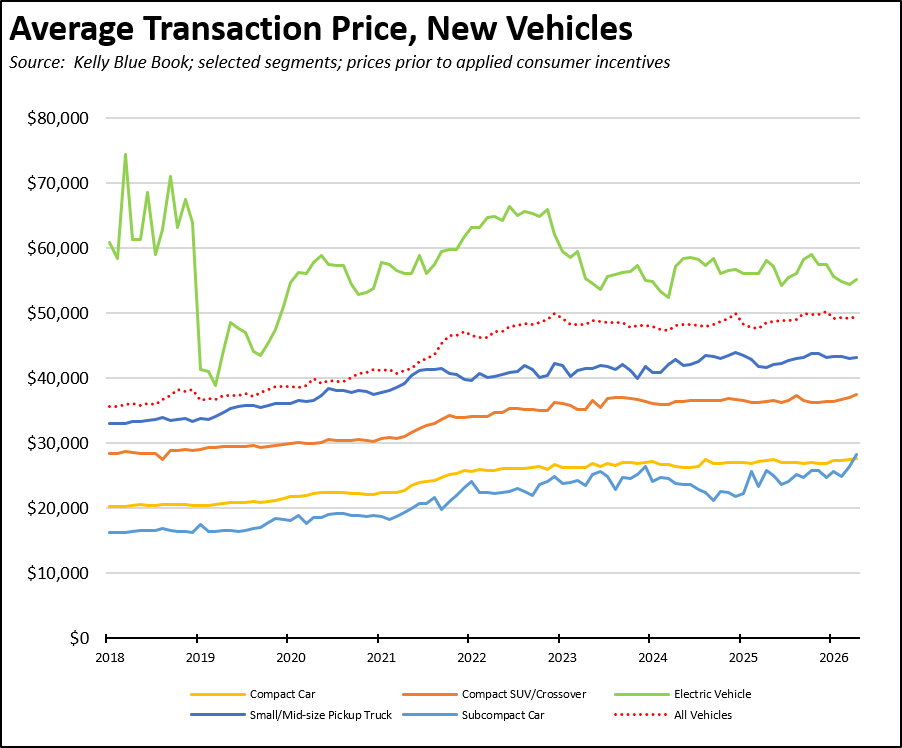
Because of sluggish sales, however, incentive packages have been high. Kelly Blue Book reports that incentives for electric vehicles in April averaged $7,600, more than double the overall industry average. At 13.8% of average transaction price, electric vehicle incentives were down somewhat from March (14.6%), but were still higher than the same month in the prior year.
This level of incentives again indicates that the primary effect of subsidies—such as the now-expired federal tax credits—is to keep prices high, transferring the value of such subsidies from consumers to producers. At $7,600, the incentives now provided through the market are just above the previous maximum amount of $7,500 under the federal tax credits, and above the average tax credit of $6,700 consumers actually received in 2023.