
Below are the monthly updates from the most current January 2026 fuel price data (GasBuddy.com) and November 2025 electricity and natural gas price data (US Energy Information Administration). To view additional data and analysis related to the California economy visit our website at www.centerforjobs.org/ca.
US EIA has completed their annual revisions to the natural gas data, beginning with 2023, and these updates have been incorporated into the Center’s database. This month’s report, however, does not include the November natural gas prices for California as the underlying data has not been reported for November and the previous month.
Overall, California continued to have the highest fuel and electricity prices among the contiguous states and DC, while the relative ranking for the average residential electricity bill again showed marginal improvement as rates rose faster in the other states due to winter prices, pipeline restrictions, and state clean energy mandates.
Fuel prices continued to moderate to $4.26 a gallon for regular gasoline as the California market completed the mandated annual transition to winter formulations, which cost less to produce and which increase supply through a higher yield of fuels from each barrel of oil. Prices, however, were below $2.50 a gallon for regular gasoline in 9 states in January.
Inflation
For the 12 months ending December, the California CPI rose 3.6%. In the same period, the US CPI rose 2.7%. Using the same Department of Finance weighting formula, Food at Home (groceries) rose 1.7% in California compared to 1.9% for the US. Food Away from Home (restaurants and takeout) rose 3.7% in both California and the US. Note that data for October was not compiled due to the federal shutdown. The required months to calculate the California numbers are consequently extrapolated from the reported data.
California Gasoline Taxes & Fees
Gallon of Gasoline
As we have discussed in prior reports, in the absence of current Energy Commission data, we have begun our own estimates using the Commission factors and the new OPIS data. In January, $1.45 (34.1%) of the price of a gallon of regular gasoline was paid to cover state, local, and federal taxes and fees.
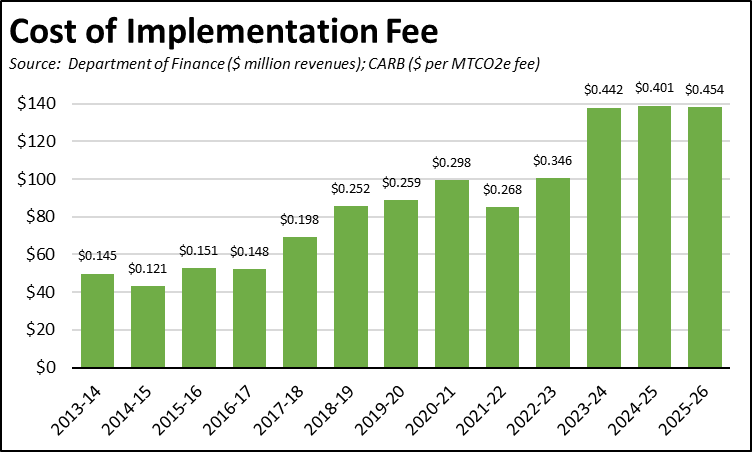
This number, however, does not incorporate all taxes and fees applied to fuels in California and not in other states. For example, the calculations do not include the Cost of Implementation fee charged by Air Resources Board to cover agency costs of implementing the state climate change program. Under this cost item, the agencies basically determine how much they want to spend on the program and then, often with minimal review by the legislature, apportion these costs to California business based on their reported emissions.
This fee has seen substantial increases in recent years. Compared to 2014-15, the fee has grown 474%, while total state revenues from this charge have grown by 421%. Based on the 2023 emissions used to calculate the current fee, about 60% of the total fee revenues contribute to the higher cost of producing and transporting fuels in this state.
California Carbon Taxes: LCFS and Cap & Trade
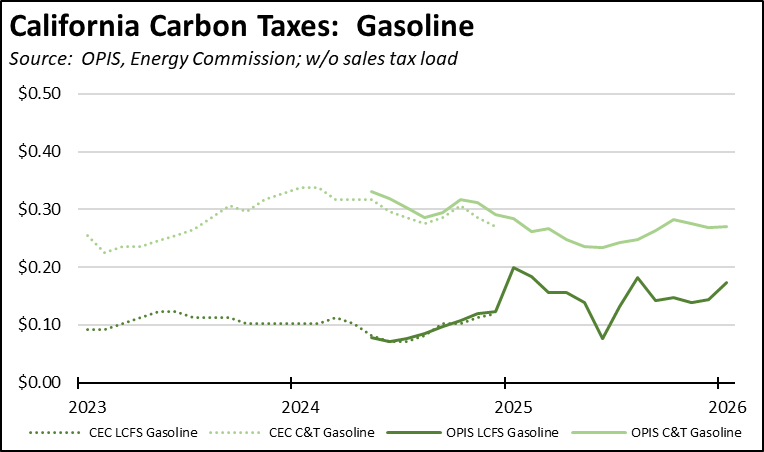
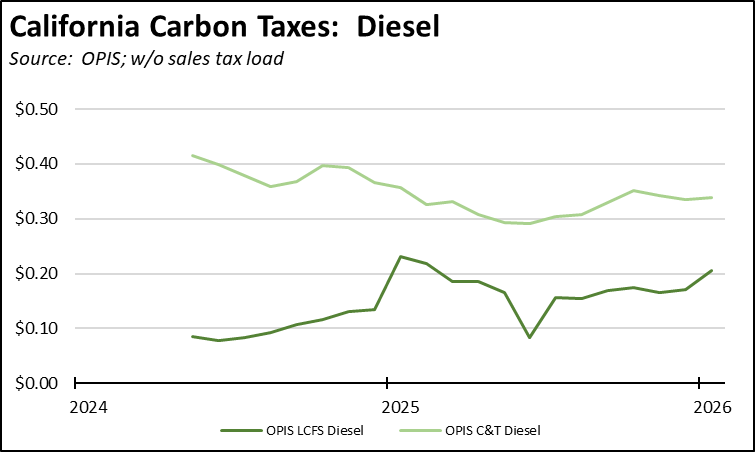
In January, total LCFS charges incorporated in the price Californians pay for fuel rose 3 cents for gasoline 4 cents for diesel, while the Cap & Trade components showed only a marginal increase. The costs shown in the table are for the penultimate month-to-date numbers from the OPIS Carbon Market Report, adjusted to incorporate state and local sales tax to account for the full additional costs imposed by these regulatory fees on fuel buyers. Certain Data or Information Provided By: Oil Price Information Service, LLC. Distribution of OPIS data without permission from OPIS is prohibited.
Combining the OPIS data (without the sales tax component) with the previous Energy Commission estimates, Cap & Trade costs have been relatively stable in the past few months, while LCFS costs are now showing a rise under the new regulations that became effective in the summer. Note that both charts include both the Cap & Trade components charged at the rack and levied on production from the OPIS data, and only the rack component in the Energy Commission data.
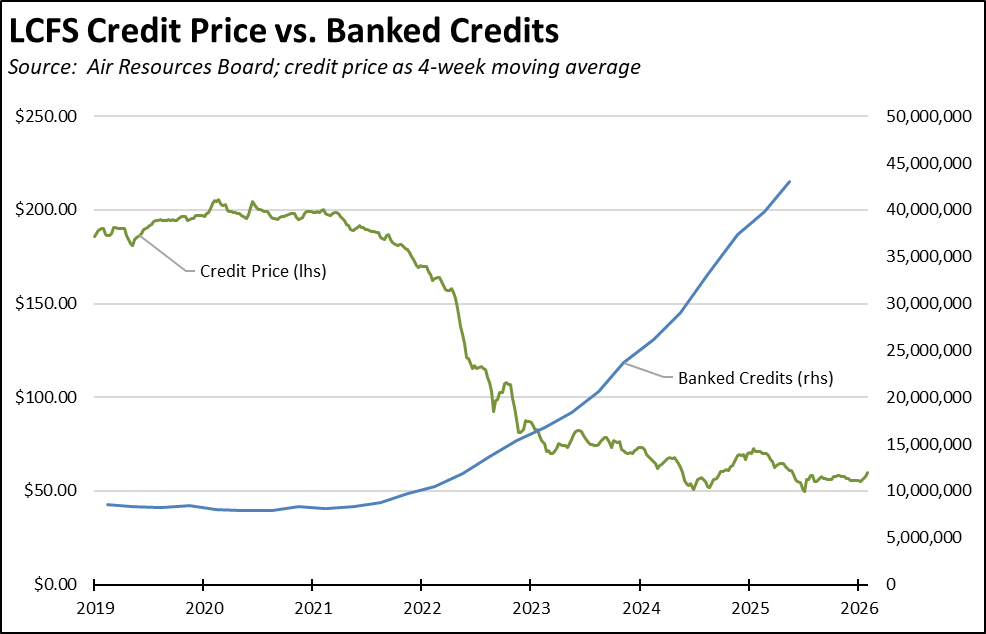
The underlying credit prices for LCFS showed a sustained rise in January after relatively stable performance in the second half of 2025. Longer term price effects, however, remain governed by the extreme amount of banked credits still remaining in the system.
California vs. Rest of US Diesel Price
Above Other States
(CA Average)
The January average price per gallon of diesel in California eased 7 cents from December to $4.90. The California regulatory and tax premium above the average for the US other than California ($3.46) eased to $1.44, a 41.8% difference.
price
In January, California had the highest diesel price among the contiguous states and DC.
Range Between Highest and Lowest Prices by Region
above Other States
(Central Sierra Region)
The cost premium above the US (other than California) average price for regular gasoline ranged from $1.39 in the Central Valley Region (average January price of $4.13), to $1.70 in Central Sierra Region (average January price of $4.44).
Highest/Lowest Fuel Prices by Legislative District:
California Residential Electricity Price
Rest of US
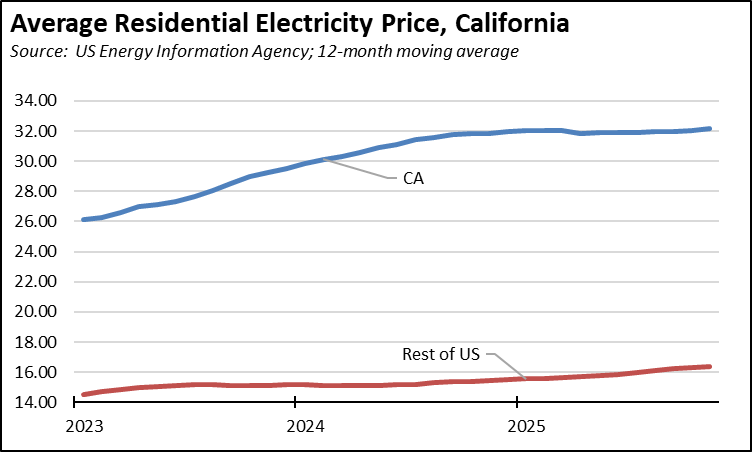
California average Residential Price for the 12 months ended November 2025 was 32.16 cents/kWh, 96.6% higher than the US average of 16.36 cents/kWh for all states other than California. California’s residential prices were the highest among the contiguous states and DC.
The best that can be said of California prices, however, is that after its recent meteoric rise, the growth in rates slowed in the 4th quarter of 2023. With rates showing similar gradual increases in the rest of the US, a substantial gap in this cost of living and cost of doing business component still shows little sign of diminishing.
California Residential Electric Bill
For the 12 months ended November 2025, the average annual Residential electricity bill in California was $1,882, or 89.3% higher ($888) than the comparable bill in 2010 (the year the AB 32 implementation began with the Early Action items). In this same period, the average US (less CA) electricity bill for all the other states grew only 32.0% ($437).
In 2010, California had the 9th lowest residential electricity bill among the contiguous states and DC. In the latest data, it had the 17th highest.
Residential bills, however, vary widely by region. Transforming the 2022 data recently released by the Energy Commission, estimated annual household usage is as much as 82% higher in the interior regions compared to the milder climate coastal areas, and substantially higher when comparing across counties.
Rest of US
For the 12 months ended November 2025, California’s higher electricity prices translated into Residential ratepayers paying $13.1 billion more than the average ratepayers elsewhere in the US using the same amount of energy. Compared to the lowest cost state, California households paid $17.0 billion more.
California Commercial Electricity Price
Rest of US
California average Commercial Price for the 12 months ended November 2025 was 25.96 cents/kWh, 110.2% higher than the US average of 12.35 cents/kWh for all states other than California. California’s commercial prices were the highest among the contiguous states and DC.
California Industrial Electricity Price
Rest of US
California average Industrial Price for the 12 months ended November 2025 was 21.60 cents/kWh, 169.3% higher than the US average of 8.02 cents/kWh for all states other than California. California’s industrial prices were the highest among the contiguous states and DC.
Rest of US
For the 12 months ended November 2025, California’s higher electricity prices translated into Commercial & Industrial ratepayers paying $21.2 billion more than ratepayers elsewhere in the US using the same amount of energy. Compared to the lowest rate states, Commercial & Industrial ratepayers paid $27.7 billion more.