
As fans head into stadiums today for Opening Day they may not realize that a proposed ballot measure is already changing the rules of the game, creating winners and losers not based on balls and strikes, but based solely on where a team’s owner lives.
Under a proposed tax increase proposed for the November ballot, California could begin taxing not just income, but the underlying value of professional sports teams themselves, but only if they’re owned by Californians.
The 2026 Billionaire Tax Act would impose a 5% tax on the net wealth of billionaires living in California. In the world of sports, that includes ownership stakes in professional franchises across baseball, football, basketball, soccer, hockey, and beyond. But the way the measure is written creates a striking imbalance.
If your team is owned by a billionaire living out of state, there’s no impact. If your team is owned by someone living in California, the full value of that franchise gets swept into the tax calculation. Even partial ownership by a California resident can trigger the tax if it represents a controlling interest. In those cases, the full value of the team, not just the share owned, would be counted.
That means the Los Angeles Dodgers—owned by Illinois resident Mark Walter—can continue spending freely, stacking rosters with stars like Shohei Ohtani and others. Meanwhile, the San Diego Padres—owned by California resident John Seidler—would face new financial pressure, simply because of where their ownership lives.
And that’s where the real pressure begins.
Most of the assets held by those targeted under this tax aren’t liquid. They’re tied up in companies, stock holdings, and long-term investments. Selling those assets in large quantities to pay a wealth tax risks depressing stock prices—impacting not just billionaires, but pension funds and everyday investors.
Sports franchises are different. They generate steady cash flow. And under this proposal, that cash flow becomes a likely source to cover a tax bill.
So what does the scoreboard look like?
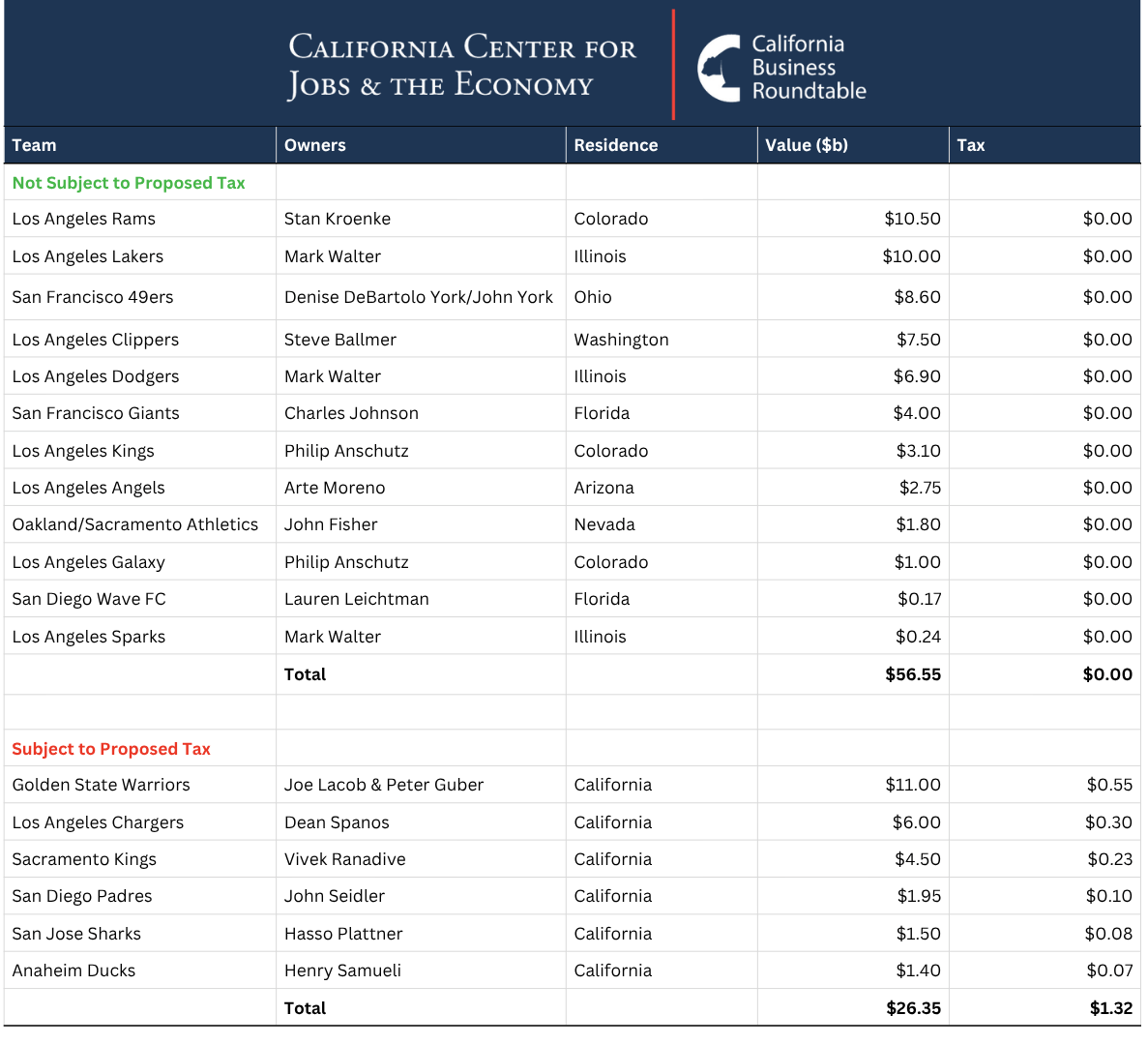
Teams with a combined value of $56.55 billion—because they’re owned by out-of-state billionaires—would face no impact at all.
By contrast, California-owned teams valued at $26.35 billion would add an estimated $1.32 billion to their owners’ tax bills.
That imbalance doesn’t stay in the owner’s box. It shows up where fans feel it most: fewer resources for player salaries, fewer investments in stadium upgrades, and for families already stretched thin, higher prices for tickets, concessions, and the overall game-day experience.
Estimates based on team revenues suggest that covering the added tax burden could require price increases across the board. For example, average ticket prices for some teams could rise by double digits, while something as simple as a beer at the ballpark could climb noticeably higher.
In the following table, a potential tax surcharge is calculated by amortizing the potential tax hit (using 5 years and 7.5% interest as in the proposed measure) and comparing it to total revenues, generally shown in the Forbes analysis from 2024 and not including revenues pledged against stadium debt repayments. Average ticket and beer prices are taken from various web sources. The post-tax amounts are what would result if the full tax surcharge estimate is applied.
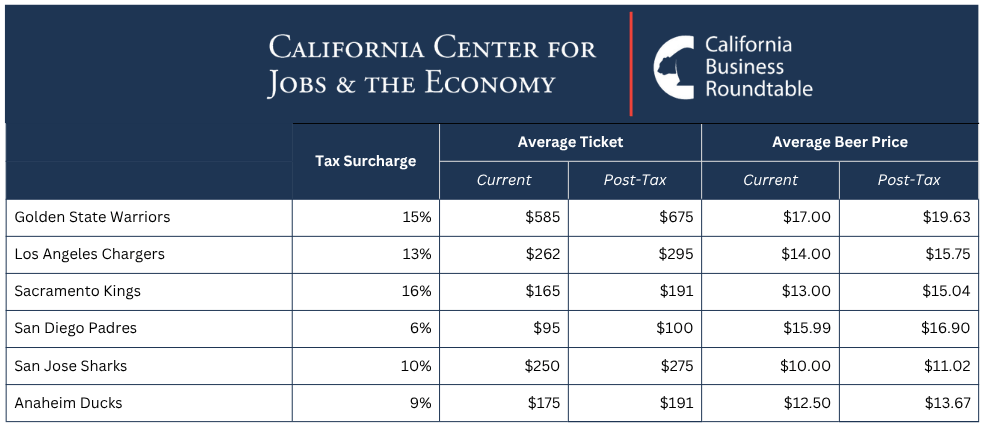
These are averages, and real-world responses will vary. But the direction is clear.
On a day meant to celebrate America’s pastime, the takeaway is hard to ignore: this proposal doesn’t just change tax policy—it changes the economics of sports in California.
And in a state already struggling with affordability, it raises a bigger question: who really ends up paying the price?
But the impacts go beyond just the direct fan experience. Sports are not just entertainment—they are a major economic driver, much like major entertainment events held at these stadiums. Nationwide, spectator sports generate more than $100 billion in economic activity and support hundreds of thousands of jobs. In California alone, the sports industry produces more than $11 billion in economic output each year. That activity supports local restaurants, hotels, retail, and thousands of workers whose livelihoods depend on game-day spending.
Fewer fans at games or higher costs for the experience doesn’t just hurt the sports teams California is famous for, it will likely have an impact on the local economy as well, including restaurants and economic activity near and supported by these sporting facilities.